Examining Whiteness
You are here: /commentary/examining-whiteness
Do not expect to read through this quickly
Take 20 minutes to think, write notes, and reflect on what you are reading.
Geography
As a rule of thumb, people live on different parts of the Earth and mostly stay near their home. Even travelers return to some specific location most of the time. Geographically, "white people" live in the USA, Canada, Western Europe, and China. This is because white Asians are mostly Chinese, or possibly Japanese. Brown people like Cambodians are in a different part of Asia.
The focus is often Western Europe and North America when talking about white. There are white people in all parts of the world including Middle East, Africa, and South America. They may not identify as a coloration of the epidermis, possibly they may associate themselves with other concepts such as religion, job role, geographical area, or country.
In Western Europe and North America, potentially WENA, there are concepts that make people "white". These are colonialism, immigration, industrialization, and religion. Traveling is a big part of immigration so what is often meant is free movement between various regions on Earth. This shapes cognitive processes, behaviors and traits. Keep in mind that other people may have different perceptions on how humans identify with one another.
To get things out of the way, in a menagerie of wild animals, affiliating as white might result in a polar bear, white tiger, albino elephant, and white locust attempting to start a family with one another. Families are diverse and in some parts of Earth, this may very well be the intention and result. In other parts of the Earth, people may be wondering why the white tiger wont play with the rest of the tigers or why the polar bear doesn't talk to the golden bear or black bear.
Breeding Behaviors
White people have a few genetic groups they may not be aware of. Focusing on WENA, with Central and Northern Europe as an approximate point of origin, there are White Middle Easterners, White Indians (Native Americans), and White Europeans. Travel and migration has made it possible to enter and leave each others home. The similarities however, may have such a big contrast in some areas that they can no longer communicate very well.
Latinos or Latinas with a lighter complexion don't necessarily associate as white, even though they have light skin. This is because they generally don't follow a pattern of industrialization and prioritize time with family over work, achievement, success, and accolades. East Indians, near China, will often have a tan even with lighter complexion and White Africans will often resemble latinos or latinas but this isn't always true.
With most human development going regional and multi-culture families or friendship groups being quite normal, being white is not much different than saying someone is a blonde, brunette, or red head. Families often breed away from family, within their genetic group, or start moving towards their family but in a similar genetic group.
Not too many people pay attention to what is going on in other regions. Occasionally there might be a request to observe and comment on a different area. People like traveling, but not too many people like to work. This is evident in the amount of jobs being automated and people preferring jobs with the least amount of hours that still allow paying all the bills. This is viewed as not the best decision for human development but a decision that is made collectively among all the humans.
Militarization
This human behavior is mostly in decline globally. The United States, India and China being the last few countries that are military oriented. Western Europe and the UK are often included in these conversations as being pro USA or pro India. Realistically, China may mostly be in charge of military operations in the future through the U.N. Peacekeeper program. They can theoretically spin up an army of 200 million in less than 2 years. In contrast the U.S. has 2 million soldiers available for service. India which has a similar population size focuses mostly on officer training even though they do have an army and other military technology.
Criminal Justice
Globally, jails are the least popular policy. Most governments focus on economic detention and behavioral colonies that allow nurses to document and observe behaviors on 10-12 hour schedules so they can provide treatment plans. Consider the largest jail in the USA can hold 7,000 prisoners. Contrast that with a small town of 250k to 500k residents. All of them under economic detention and undergoing therapy and treatment.
Outside of specific areas, the population is over 90% law abiding in the USA focusing on vape, caffeine, and mixed drinks for recreational drug use and having only minor infractions such as driving to fast or disliking their work environment leading to an HR infraction. Losing a home due to lack of economic resources is also viewed as an infraction but one that can often not be helped with certain policy makers.
The police mostly drive around to make sure everyone is still law abiding, and they occasionally show up to court to give their side of the story on why they arrested someone and put them in jail.
Covid
This global outbreak affected everyone, and many people are still recovering from the incident in "2018". The most recent outbreak was likely around 2023 and the healthiest people in the United States will be mostly recovered by around June of 2026. For everyone else, it will likely be 3-4 years before they are fully back to normal.
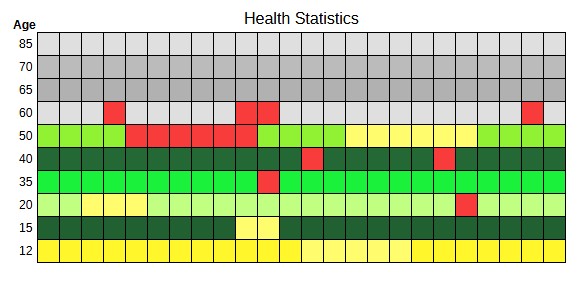
This puts a new context on workplaces and the 25-32 hour workweeks with 45-60 days off begins to make more sense. It is uncertain if incidents like these will be prevalent throughout our lives going forward. On a simple analysis, a large virus outbreak has kept people at home and working part time or intermittently for several years now.
Workplaces
In the past, work was centered around large corporations with many locations throughout the country. People looked for work, a full time job with lots of benefits. These jobs were abundant and paid for all the expenses. Many women were allowed to stay home and take care of their children. It was very difficult to not find a job.
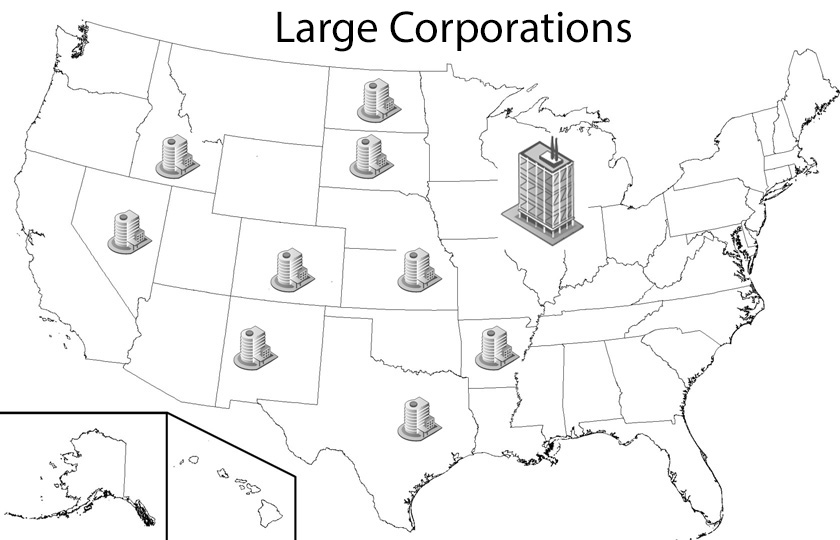
Recently, a town of 500,000 people may have less than 25,000 jobs from a large corporation. Everyone else gets their income from small businesses, independent work or some other source like retirement savings or being dependent on family even at the age of 50 to 60 years old with no disability but also with no savings or income.
With small businesses being so popular and easy to run, their owners being able to pay for many of their expenses without loans or credit cards, the independent office and micro startup have become a big economic driver in the United States.
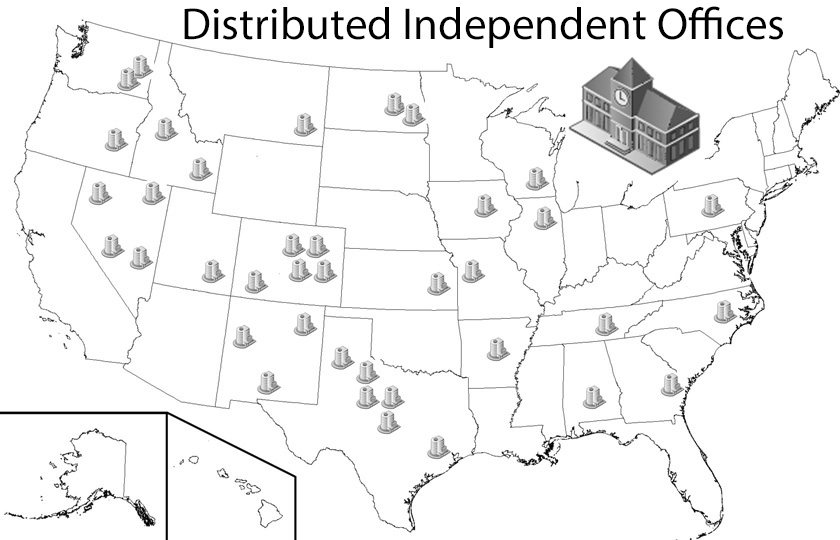
The advantage of this type of economic model is that the Federal Reserve can make equal and non discriminatory policies on access to money for startups or classification of disability. A person that goes out of business may need to return to college, pay rent, food, and utilities while there, and need some extra money for rents and equipment. The disadvantage is that not everyone knows how to do their own accounting, business administration, and marketing.
Consider that a small business with 15 employees each making $45k per year would require a $775k payroll budget each year not including other costs. A more realistic number for small business is a $1.7M payroll budget for a small business with 25 employees each making $60k. A business with 1,500 employees averaging $85k per year would have a payroll budget of $127M plus taxes. This would be considered relatively small to a large enterprise, many of whom don't track all their expenses and leave the tax payments to the accountant.
A lot of independent workers chose to work completely alone and have less than 5-15 workers they "manage" through independent work agreements. This means everyone works independently and there might be an overall project manager that gets paid a little more to get everyone's work lined up or to be available for questions from other workers on their team.
Religion
Christianity is the most of described religion that someone would affiliate with. However, many religions are becoming closed off to public observation and more exclusive with their existing membership. A lot of people in Western Europe and North America identify as atheist or non religious and do not have a church to go to. Some churches are open to the public briefly on either Saturday or Sunday and one day throughout the week, often a Wednesday or Thursday.
Religion has some importance in the WENA region but most thought processes are heavily based on scientific thought, logic, and reason. This means religion is approached with the same thought philosophy.
Most people are open to being friends with others of any religion or no religion but expect kindness and respect when interacting with others. Proselytizing or asking someone to accompany them to a religious location after they've said no is viewed as an aggressive behavior and can lead to loss of friendship over behaviors and not so much over a religious affiliation.
Conclusion
White is a concept that people gravitate to and can include people of different skin colors. For example, someone that has specific expressions may be considered white or kinda white regardless of their actual coloration. These concepts include work, traveling, industrialization, affects of militarization, criminal justice, and religion. It can also include music, clothes, speech, activities, interests, and hobbies.
All Rights Reserved. Copyright © 2019-2025.