International Academic Comparison
You are here: /announcements/international-academic-comparison
Studying is a well known pass time in many nations and developed nations tend to make this popular pass time into part of many job roles. Its been said that the more modern question about workplaces isn't "What do you do at work?" but instead "What are you studying?", school is then viewed as preparation and job training for a career goal and it includes certification and ranking of skill sets.
Being certified means being verified, to a certain level of quality and consistency that is representative of the expected performance for the area of certification.
In a modern job interview, the interview is mostly done by third parties, and the interviewee is brought in at the end to be introduced to the potential workplace. They usually just need documentation of identity, payment information, and to sign off on basic agreement about workplace expectations. Most people don't have references anymore, they have verifiable dates of employment and a job role or title. Most of the job role requirements can be verified at the new employer within two weeks. There are court procedures for recovering wages that were obtained through falsely stating qualified job roles in a placement search.
What does all this have to do with school?
In 2016, it was determined that education in the US is very important for its gene expression but that the students mostly learn better on their own. Coming into the classroom for a list of instructions, some peer review and conversations, and to verify the quality of their work or ineligibility to proceed further in that area of study.
US school enrollment is classified into the following areas:
- Daycare
- Socialization
- Skill Verification
- Peer Review
- Performance and Ranking Assessment
- Tutoring and Polishing
- Exploring Different Areas of Study
- Learning
For many teenagers, the question has been proposed about them getting into a relationship with someone over the age of 20 and eventually their after school jobs should be able to cover rent, food, and utilities by age 16. This will drastically lower the age of dependency on other adults to less than 30 hopefully and no older than 35.
Globally, the appropriate age to be done with college is seen as about 15 years old in most parts of the world. The US Academic System has been asked to consider making this happen without disturbing people in the middle of a career change or self exploration.
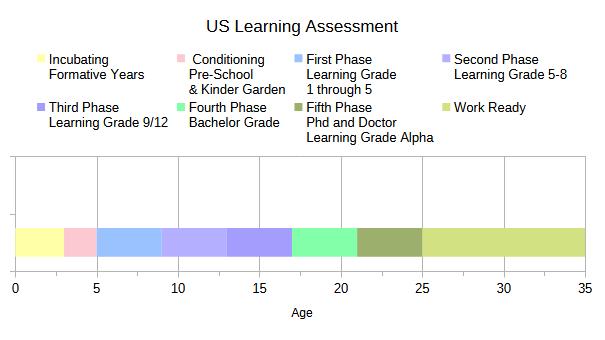
Learning Paths are Developed on Age Similarity to other Students
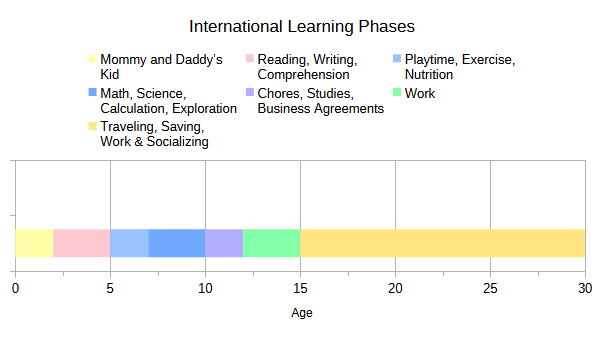
Knowledge is Increased Exponentially by Year
Realistically, students will develop differently depending on their gene expression, desire to learn, interest in topics and subjects, and how it correlates to their well being. A person may not want to learn how to cook but having more money in between jobs, more time with family, and not having to go outside everyday when working from home might be a motivator to learn. At a minimum it may encourage them to have snacks around for when they don't want to stop by for food.
When studying delayed skill sets in adult learners, the assessment will vary greatly by person. Someone may need improvement in 6th grade math, 10th grade reading, and 4th grade arts and craft. Their math skills may be stunted at long division, but some of the geometry may be filled in with arts and crafts which can then be supplemented with measurements. A different person may be mostly at 9th or 10th grade with some missed concepts preventing them from being classified as an adult.
Mostly school and college is seen as repetitive for skills learned at younger than 15 in study centered households. This means that books, studying, math games, and libraries take priority over theater, sports, dancing, and drawing. The schools are used mostly for grade assessment to be reviewed by mom and dad and for the kids to make friends who wont pick on them. Business Administration and Management is normally taught at home along with civics around 12-15 years old. There are also lessons in mean government workers, business agreements, honesty, and confidentiality.
Comparatively a B.A. degree is completed by age 24 in most U.S. Households. They may delay enrollment until age 20, enroll intermittently, or go mostly part time.
After the age of 24, except for PhDs and Doctorates, people might enroll in college for a career change, because they never attended, or to meet someone new.
More recently, the concept of being a doctor is 10th grade biology, anatomy, and an after school job as a medical assistant. The goal is to progress into a BSN, MD by age 24 instead of 28 to 32. While this is still extraneous to many people it is more representative of a doctor qualification by age 22-23 in most countries.
For doctors, nutrition and psychoactive meds can be done over a weekend workshop, they are often included in biology and the studies begin in 6th grade with things such as cianade, blowfish poison, snake venom, and spider bites. It then moves on to penecilin, anti-biotics, medicines - the 1800s doctors bag, dissecting, anatomy, surgery, and recovery. The concepts of pain killers and psychological meditating are introduced by 7th grade. The students are essentially at molecular biology and human evolvement at this point, knowing that they still have a long time to start dating, over 10 years of waiting.
Comparatively, the main difference between the US academic system and other countries is that students are introduced into economics, after school jobs, and paying taxes at a much younger age. Normally around 12-15, this includes paying taxes on allowance or after school jobs on mom and dad's taxes as a dependent. They also learn the difference in filing as a independent or head of household and can work on their own worksheet for mom and dad to review.
The graphs should be helpful in assessing studying requirements in developed nation economies, and developing an age group based learning plan throughout the life of a learner.
All Rights Reserved. Copyright © 2019-2025.