Examining US Government Policy
You are here: /announcement/examining-us-government-policy
The United States disproportionately focuses on confined detention when compared to other nations. Most places have focused on internment camps, relocation of minority populations, and building minority towns for over 100 years. This means that people who don't agree with the majority vote have the option of living somewhere else. Overall detention is viewed as being resource consuming and exhausting for people trying to exercise their freedoms.
When instigating the larger group, an often heard comment is they have the freedom to leave. Police are normally recruited from the majority group and minority groups are most often participating through attorneys only.
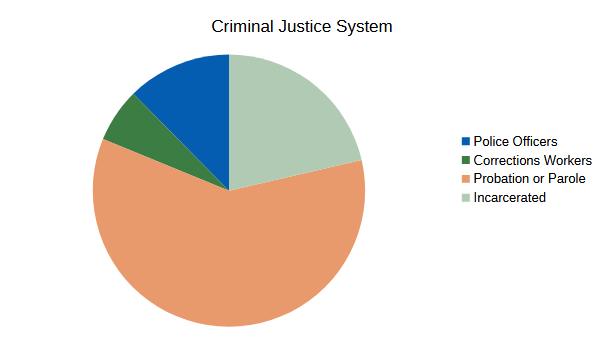
Criminal Justice System with Most Obvious Participants
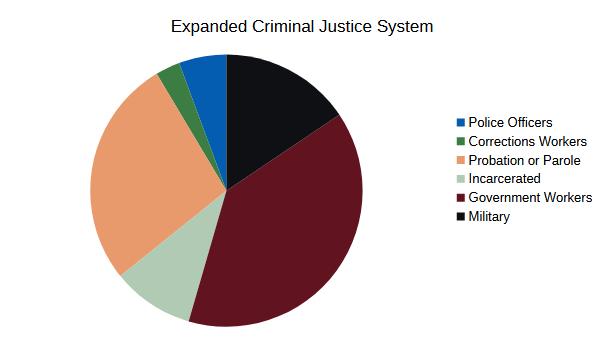
Adding in Military and Government Workers for a Slightly Different Picture
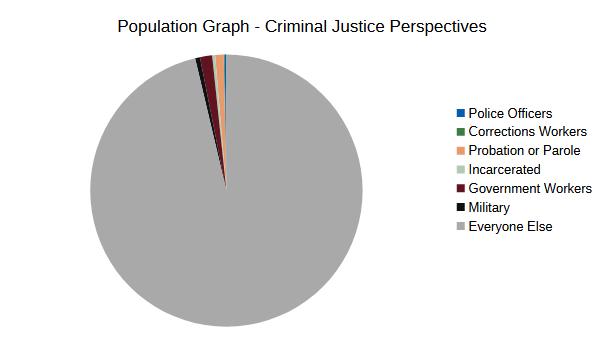
How the Criminal Justice System Looks Comparatively to the Population
Recently, in the last 8 years the US Board of Prisons, National Police Association, and the Coalition of American Social Workers released data that was combined with the UCR. While the results were inconclusive for their initial purpose, some interesting data patterns emerged.
Overall the United States is reported as having 25% of the global prison population. Estimating about 6 million people incarcerated and accounting for statistical errors and omitted data, an estimate of 25 to 32 million people incarcerted globally out of 8 billion humans emerges.
Most nations focus on psychiatric care or psychological services for minorities, e.g. anxiety from a persons own behaviors not being part of the majority expression. They also focus on relocation, establishing minority areas, and requesting lenient sentencing for some of the less grievous errors in human expression. While the world is becoming more tolerant of alternate expressions, instigating a large group will often result in the authorities addressing the person that instigated an incident.
Here in the US, this most likely caused reform because the numbers aren't always specifically clear. That is an intentional result of publishing statistics. The goal is to communicate data without publishing personal details or allowing decompiling or reverse engineering of the numerical methods.
The population estimates that there might be 11 million people on probation or parole because initially, it was reported that around 25 million people were incarcerated, or on probation or parole. However, revised numbers indicated about 5 million people were likely incarceated and another 6 million people on parole et al.
Outside of the U.S. confined detention is called prison and parole is non confined detention. There is not a concept of jail or probation. People are detained in a jail within a prison. Both probation and parole are viewed as supervised monitoring and free roaming detention. Many times the prisoner can not be incarcerated for additional crimes they commit unless a police officer happens to catch them or they admit to something in a self assessment report.
Jail is mostly viewed as an interrogation room or drunk tank in other countries, its not something for long term storage of humans.
Considering the discrepencies in vocabulary, its estimated that initially there were 5 million people in prison within the US and another 6 million people on probation or parole. This number was quickly reduced to 2-3 million people incarcerated and the current numbers are reporting 1.2 million people in jail/prison/incarcerated and another 5 million on probation or parole.
This means that there may currently be 11 million people on probation or parole and another 1.2 million people in prison with 5 million beds available for detention or incarceration.
The population tends to be law abiding in most western hemisphere nations and to be tolerant of minority groups or majorities. Ignoring each other is viewed as a peaceful and amicable solution to forced interactions with people that have little in common. This tends to reduce the criminal justice trend as well.
Most people, such as protestors will most likely face detention instead of incarceration, because of privacy rights, people that are detained at a large event no longer have their name placed into a database unless they are checked into a station. The police might have some physical paperwork that is often destroyed after some time.
People who have done prison time, often have their records deleted or sealed within a few years of release. They can not be made to remember that they are a criminal who has been incarcerated and forced to associate with their previous conduct. An employer will often get a yes or no determination on whether an employee is able to work at a certain job site. They must still pass the rest of the interview process and communities are forbidden from gossiping about people who can't find a job. It violates their economic privacy.
Many people do self disclose a minority status or as having been recently incarcerated. This might be a requirement for some time in various areas because of consent laws in dating. The disclosure and memory retention period will vary from 2-3 years, 5-6 years, or up to 10 years with omission of less important details after 5-6 years.
For many people a disclosure of recent criminal conduct is an indicator that this person may not make a good friend at the moment. If they are still involved in criminal conduct and have not yet been caught, it might affect their income and put them under sanctions.
Economic detention and penalties such as payment for injury and fines are more popular than jail. The funds are often used to reform legislation years later. The people may ultimately decide that the laws were unjust, but there were still some court costs, and the funds should be used to reform the laws to make them more representative of current behaviors.
Since everyone needs to work to meet basic necessities in developed nations, and because most people wouldn't consider a job that doesn't provide money to go out with friends as worth the effort, economic assessment and penalty is viewed as the current era of criminal justice. Very few people will be going to jail and the courts have an interest in finding someone a job so they can pay court costs and penalties.
Voting is also a lot faster, and ultimately this defines who is considered to be in non-compliance with agreed to behaviors and is eligible for a court penalty. In the Midwest, speed limits are already at 70 to 80 MPH and freedom of movement is focused on plane tickets, train rides, and car accomodations that may be temporary, shared, or chauffeured. Globally, there is a big focus on internet communications and this requires a travel budget to visit friends and family. The communications aren't necessarily centered on social media or Silicon Valley smartphones and there is a desire to make the internet less California centric.
A question in criminal justice is, what is an appropriate amount of socialization that doesn't affect time schedules and income but still allows a tolerant level of interactions with others and an opportunity to make new friends.
All Rights Reserved. Copyright © 2019-2025.